

Plate Type Selection: The type of plate, whether corrugated or not, should be determined based on the actual needs of the heat exchange application. For applications with large flow rates and low allowable pressure drops, a plate type with low resistance should be selected; conversely, a plate type with high resistance should be selected. The choice between a detachable or brazed type should be determined based on the fluid pressure and temperature. When determining the plate type, it is not advisable to choose plates with too small a single plate area, as this can lead to an excessive number of plates, low inter-plate flow velocity, and a low heat transfer coefficient. This issue is particularly important for larger heat exchangers.
Flow Flow and Channel Selection: A flow flow refers to a group of parallel channels within a plate heat exchanger that carry a single medium in the same direction of flow. A channel refers to the flow path formed by two adjacent plates within the plate heat exchanger. Generally, several channels are connected in parallel or series to form different combinations of cold and hot medium channels.
The flow flow combination should be determined based on heat transfer and fluid resistance calculations, while meeting process requirements. The goal is to make the convective heat transfer coefficients in the cold and hot water channels equal or close to achieve the best heat transfer effect. The heat transfer coefficient is larger when the convective heat transfer coefficients on both sides of the heat transfer surface are equal or close. Although the flow velocity between the plates in a plate heat exchanger is not uniform, the average flow velocity is still used in the calculation of heat transfer and fluid resistance. Since the nozzles of the "U"-shaped single-pass heat exchanger are fixed to the clamping plate, disassembly and assembly are convenient.
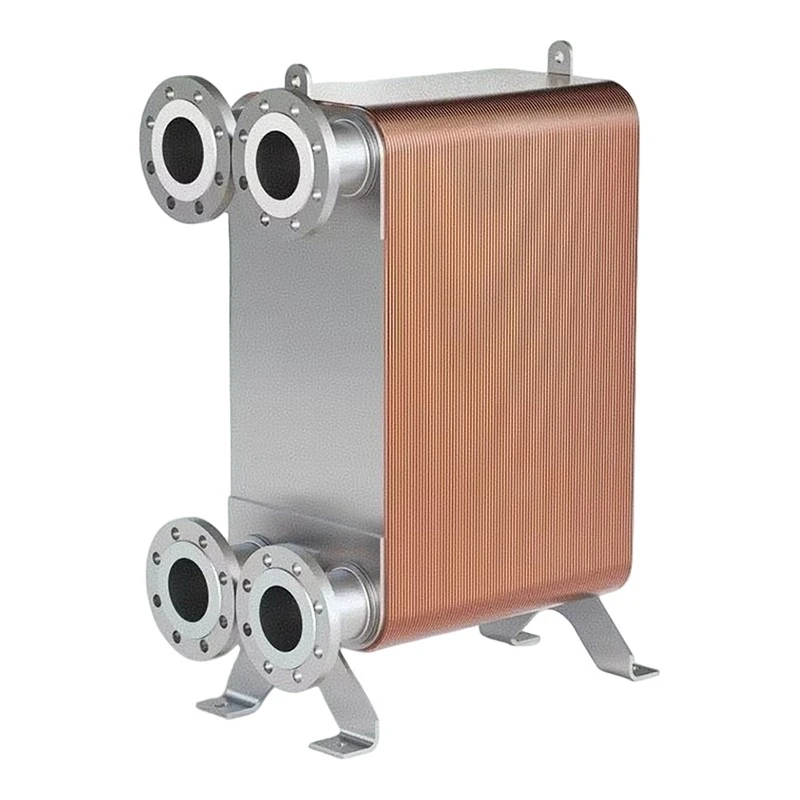
Pressure Drop Verification
In the design and selection of plate heat exchangers, there are generally certain requirements for pressure drop, so it should be verified. If the verified pressure drop exceeds the allowable pressure drop, the design and selection calculations need to be re-performed until the process requirements are met.
Calculation Methods
The calculation of heat transfer coefficient and pressure drop is obtained from the performance curves of the products from various manufacturers. Performance curves (criterion correlations) are generally derived from product performance tests. For plate types lacking performance tests, the reference size method can also be used to obtain the criterion correlation of the plate type based on its characteristic geometric dimensions. Many internationally used software programs employ this method.
Selection Software
Regarding plate heat exchanger selection software, each manufacturer generally has its own selection software based on its own plate type. Internationally used software includes HTRI and HTFS. However, publicly available general-purpose calculation software is scarce. Some domestic websites, such as heat exchanger support websites, offer online calculation software for plate heat exchangers for reference.