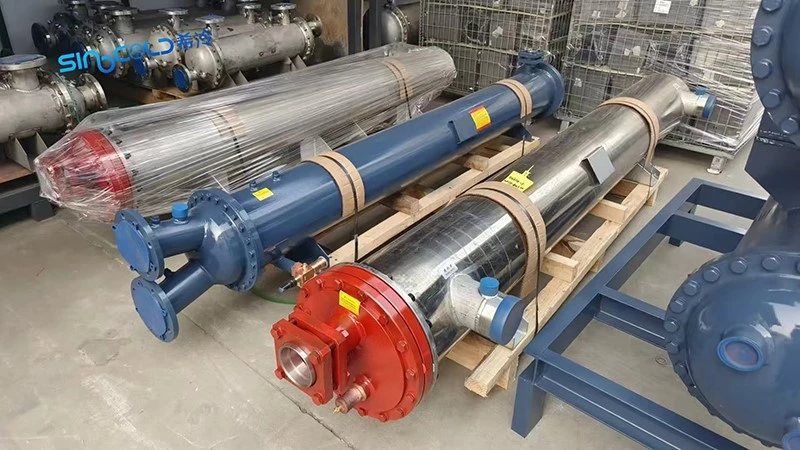
It consists of a shell and a rotor. Specifically, its main components include a medium jacket, heat transfer cylinder, scrapers, sealing devices, shaft, and drive motor. The shell is composed of an inner cylinder and an outer cylinder. The inner cylinder is the heat transfer cylinder, through which the material being processed (fluid A) passes; the outer cylinder is a jacket, through which the heat exchange medium (fluid B) passes.
The rotor rotates during operation. The outer edge of the rotor has scrapers that act as agitators and scrapers. The rotor speed is generally 100–800 rpm, varying depending on the viscosity of the material and the diameter of the equipment. For high viscosity and large diameter, a lower speed is preferable, sometimes as low as 10–20 rpm. The main characteristic of the scraper-type heat exchanger is its agitation and scraping action, preventing material from easily scaling on the heat transfer wall surface. Therefore, it is suitable for heat exchange of high-viscosity slurries or slurries containing solid particles and other fluids prone to scaling. This type of heat exchanger can be used not only as a general heat exchanger for heating or cooling but also as a reactor or dissolver with accompanying thermal processes. Common materials for scraper blades include metals and engineering plastics. The material selection for the heat transfer cylinder needs to balance thermal conductivity, corrosion resistance, and structural strength; common materials include stainless steel and pure nickel. Sealing devices can be selected as single or double mechanical seals depending on the operating conditions.
Based on application requirements, scraper-type heat exchangers have developed various structural designs, such as single-wall or double-wall designs to meet different isolation requirements, and horizontal or vertical installation methods to adapt to spatial layout.