

Volumetric heat exchangers belong to the category of indirect-contact heat exchangers. Their core principle is the deep integration of indirect-contact heat exchange and volumetric heat storage. The heat transfer medium (steam or high-temperature water) and the heated medium (cold water) are separated by a solid wall (such as a heat exchange tube bundle), and heat is conducted through the wall, achieving mixture-free heat exchange. Simultaneously, the equipment has a built-in large-capacity water storage area, serving both heat storage and buffering functions.
During operation, cold water typically enters the tank from the bottom of the heat exchanger, while hot water flows out from the top. During water flow, due to structural reasons, localized stagnant zones (cold water zones) may form, leading to insufficient heat exchange and a slower water temperature rise, especially noticeable in horizontal volumetric heat exchangers.
This type of heat exchanger experiences a large temperature drop in the heat transfer medium. During steam-water heat exchange, the condensate outlet temperature can be as low as approximately 50°C; during water-water heat exchange, the high-temperature hot water at 120–150°C can be cooled to 70–75°C, a temperature drop of 2–2.5 times that of similar heat exchangers.
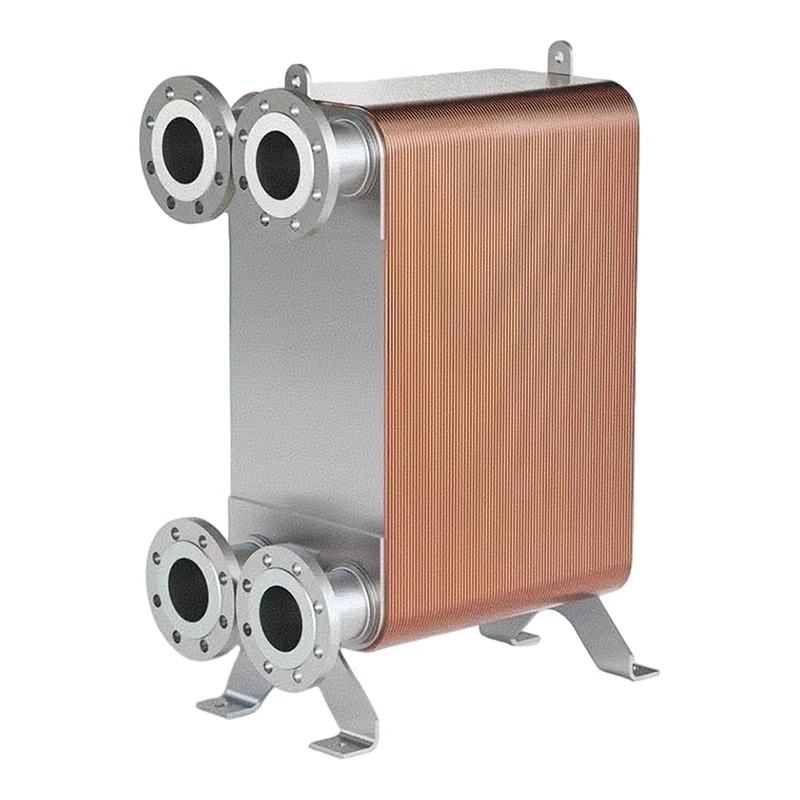
By increasing the flow velocity between the heat medium inside the tubes and the heated water outside the tubes, a transition from laminar to turbulent heat exchange can be achieved, thereby improving the heat transfer coefficient. Furthermore, structural improvements can further enhance heat transfer; for example, semi-volumetric (floating coil) heat exchangers use vibrating copper coils that generate high-frequency disturbances under heat medium pressure, disrupting the boundary layer and providing self-cleaning functionality. [18] The latest technologies (such as patent CN222993540U) increase the heat exchange area and create disturbances in the fluid by adding a foamed metal layer with herringbone-shaped guide grooves to the outside of the heat exchange tube bundle, reducing stagnant water zones and accelerating the mixing of hot and cold water. It should be noted that, according to the classification of heat transfer methods, "volumetric heat exchanger" usually specifically refers to a type of indirect heat exchanger and should be distinguished from mixing and regenerative heat exchangers.